Here is the professional English translation of your text, optimized for a formal business proposal, academic white paper, or technical report.
Current Industry Landscape and Challenges
The global cultural heritage digitization sector has entered the "Digital Twin 2.0" era. Traditional grid-based modeling and 2D archiving methods currently face five critical limitations: loss of fine detail, interactive latency, excessive data bloat, insufficient research support, and non-compliant storage protocols.
The Proposed Solution
Leveraging cutting-edge 3D Gaussian Splatting (3DGS) reconstruction technology, this solution integrates micron-level non-destructive scanning, specialized AI semantic large models for cultural heritage, a classified storage system for sensitive data, and a cross-institutional data-sharing framework. It aims to establish a standardized digital asset repository for all movable cultural relics—including ceramics, bronzes, paintings, ancient books, excavated artifacts, archival documents, and intangible heritage collections. This repository is fully compliant with international CIDOC standards and domestic regulations such as the *Measures for the Management of State-owned Cultural Relics Data*. The system is engineered to simultaneously address six core operational requirements: preventive conservation, archaeological research, archival documentation, online/offline exhibition, artifact restoration, and digital rights authentication.
Global Market Context
The global cultural heritage digitization market is projected to exceed $7.8 billion by 2026. While museums in Europe, North America, Japan, and South Korea have fully adopted lightweight 3D Gaussian Splatting archiving, domestic cultural heritage institutions are currently accelerating large-scale digitization surveys. There is an urgent demand for high-precision, reusable, and secure digital carriers for millions of movable artifacts. This solution bridges the technical standard gap between domestic and international frameworks, facilitating cross-border academic collaboration and the digital application process for World Heritage sites.

1. Pain points in cultural relic collection
Traditional contact scanning easily damages fragile cultural relics such as silk and paintings;
conventional 3D meshes lose-level details of cultural relics; the collection efficiency of small
cultural relics is extremely low; and 2D images cannot provide 3D quantitative data to support
global cultural relic restoration judicial appraisal work.
2. Pain points in data application
Traditional 3D models suffer from loading lags, making it difficult to spread online globally;
the lack of specialized AI cultural heritage significantly slows down global cultural relic
research efficiency; digital assets cannot be integrated across various business systems;
and without a unified world model foundation, it is difficult to link with global cuttingedge
cultural heritage interactive devices such as robots and 3D printers.
3. Pain points in data storage and compliance
Original cultural relic data is stored in a scattered manner without a system; the storage
architecture does not comply with international OAIS and domestic cultural relic classification
standards; massive models drive up the global cost of collection archiving; cross-regional
academic sharing lacks encrypted permission mechanism; and precious cultural digital
assets face the risk of global leakage.
Equipment Coverage:
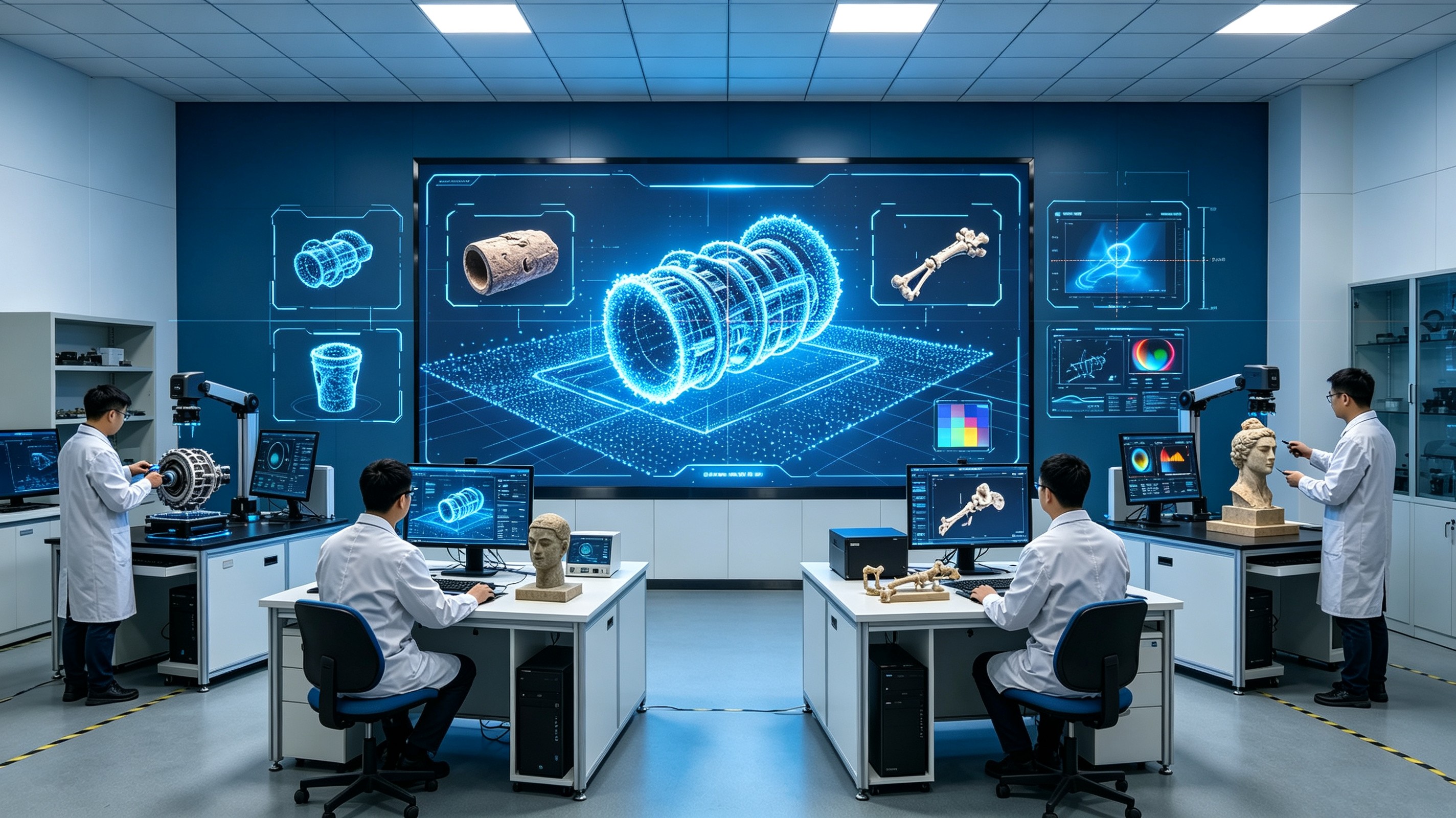
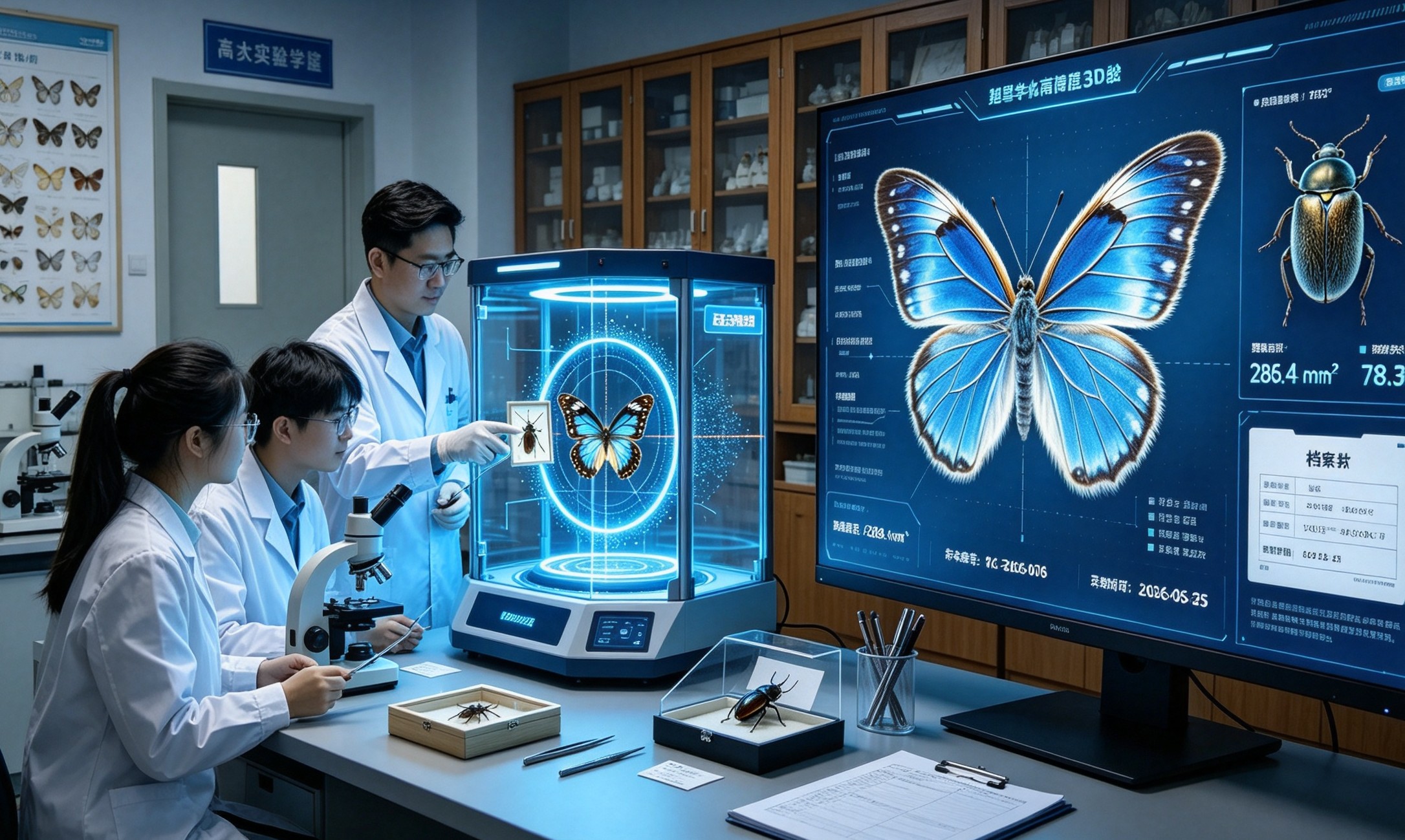
The self-developed desktop 3D optical scanner features a maximum capture size of 68cm, providing full coverage for small to medium-sized cultural relics such as jade, bronzes, ancient books, and excavated fragments. For large artifacts, a portable scanning component enables automatic segmented stitching. The entire process is non-contact and consumable-free, adhering to a globally universal non-destructive acquisition standard.
Cutting-edge Acquisition Technology:
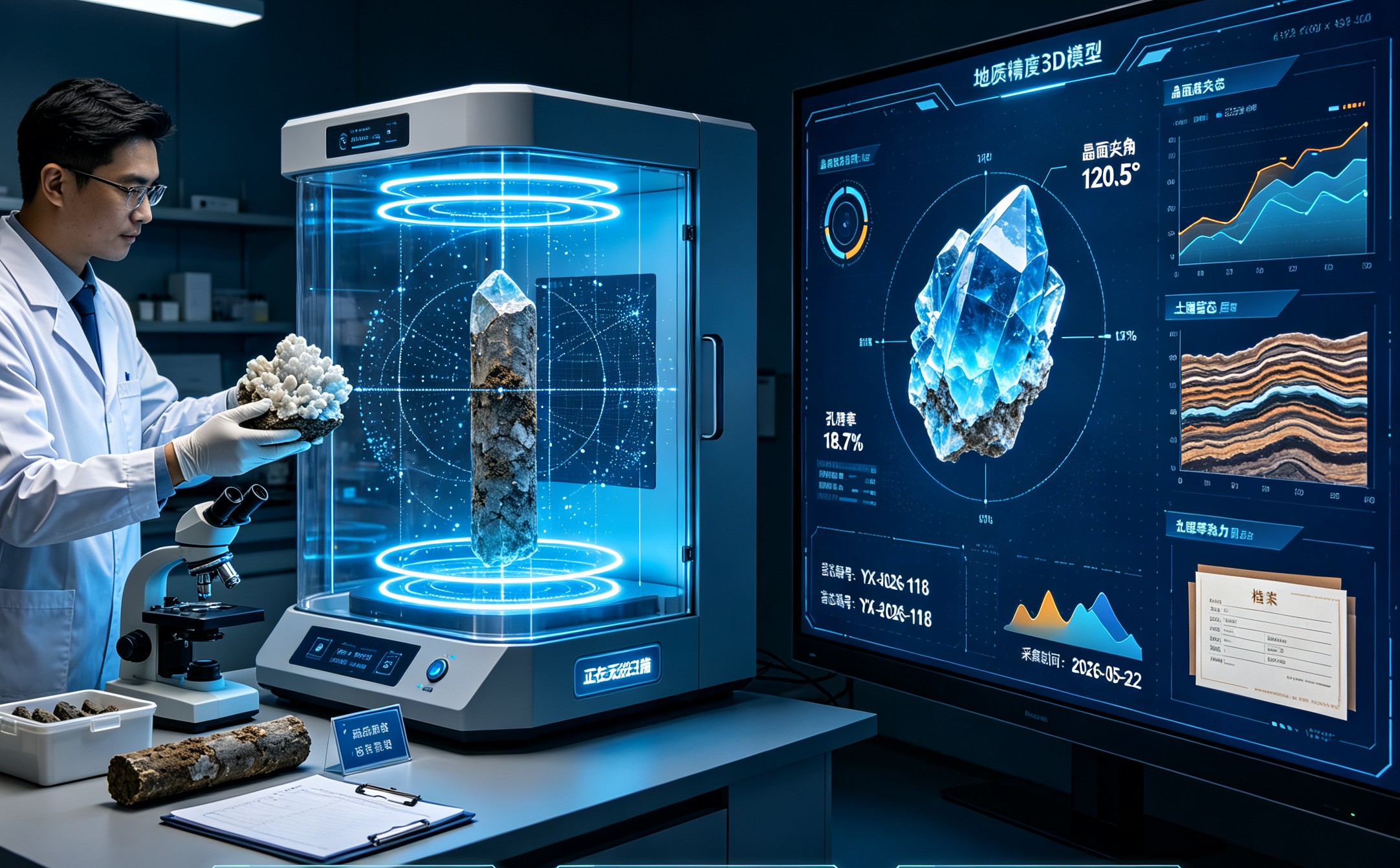
Equipped with three internationally mainstream technologies—0.01mm micron-level structured light scanning, multispectral synchronous imaging, and real-time Gaussian Splatting reconstruction—it simultaneously captures microscopic textures and invisible repair marks. It generates lightweight digital twins of cultural relics upon acquisition, eliminating complex post-processing modeling steps.
Standardized Acquisition Processes by Field:
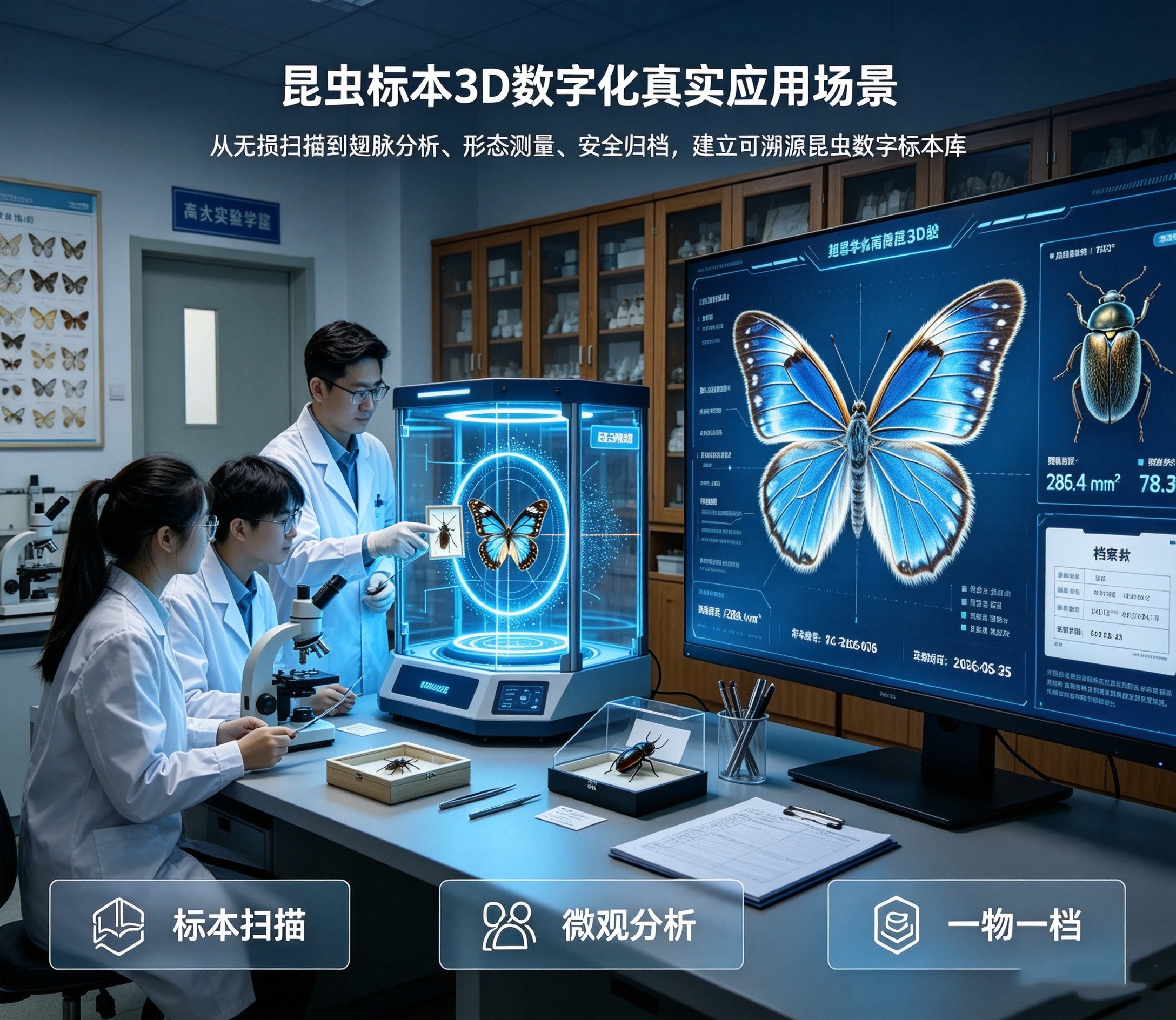
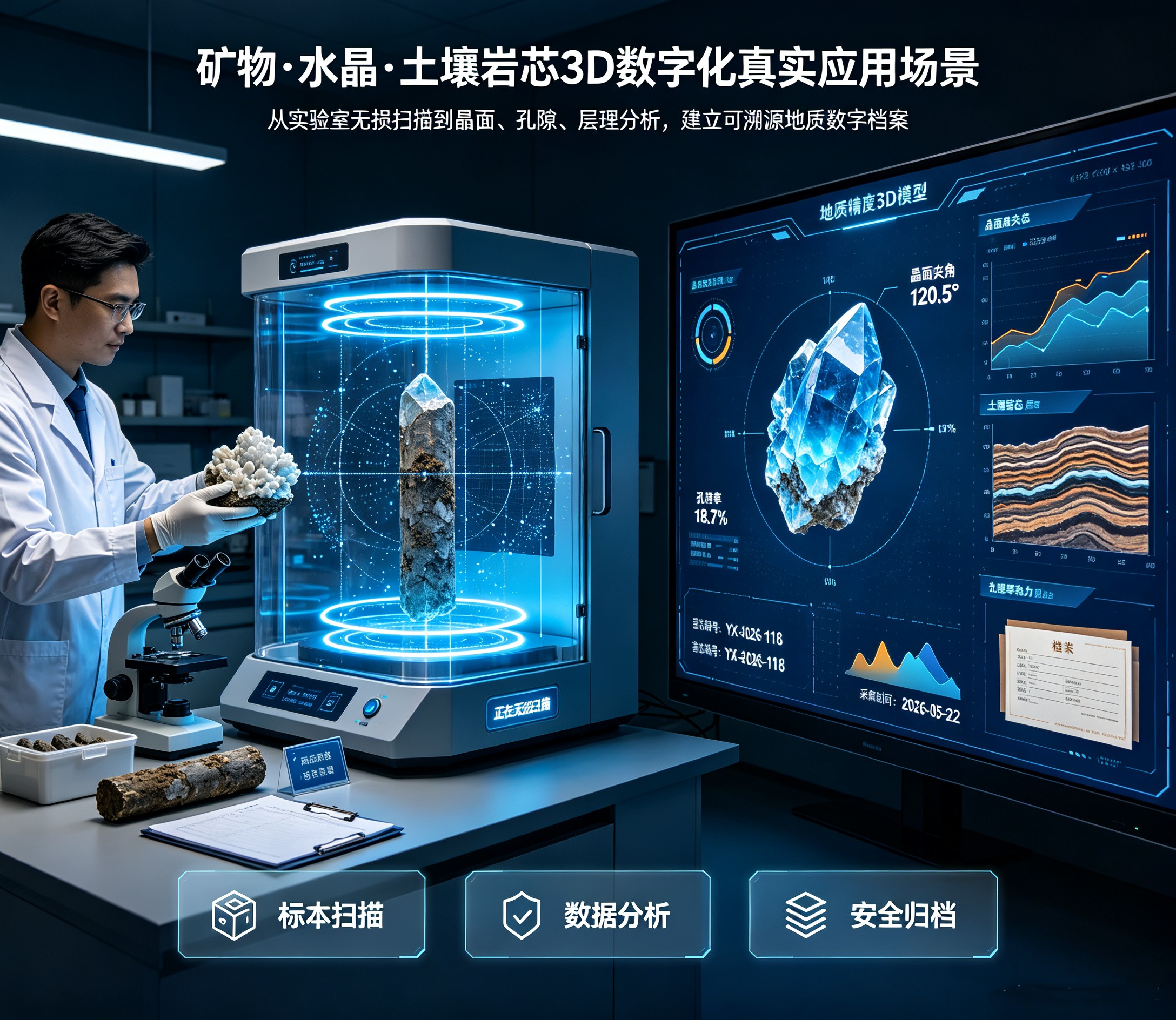
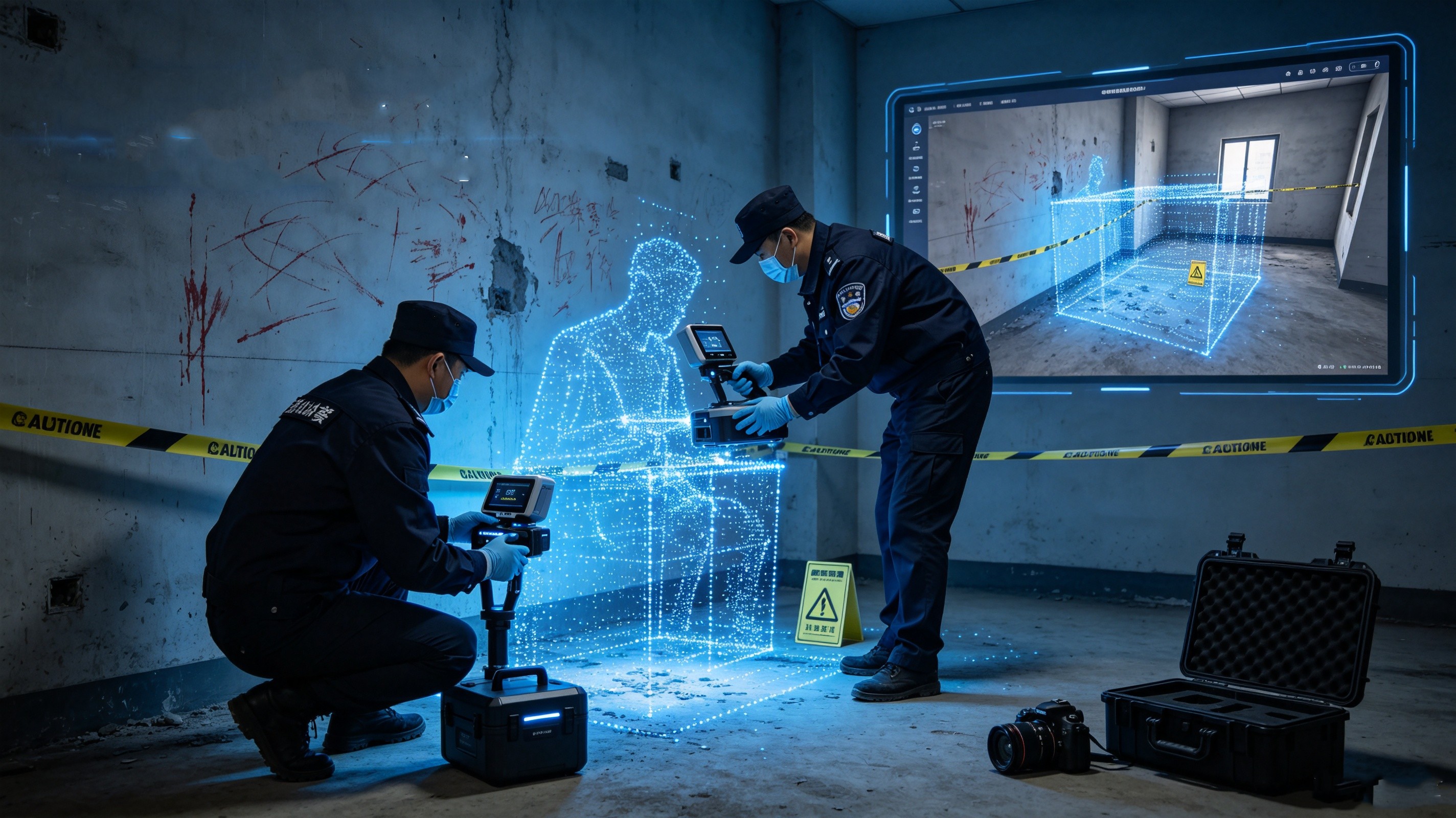
For museum archiving and grading, it enables one-item-one-code digital filing; for archaeological sites, it provides portable acquisition with AI fragment restoration and stratigraphic world model correlation; for archives, it achieves three-dimensional preservation of the physical characteristics of ancient book paper; and for cultural heritage bureaus, it facilitates rapid 3D quantitative evidence preservation for case-related artifacts, adapting to the business processes of various cultural and museum institutions worldwide.
Core Global Value:
Non-contact operation prevents damage to cultural relics, while automated acquisition and modeling efficiency is increased by 80%. It simultaneously preserves triple original digital baselines—point clouds, multispectral data, and Gaussian Splatting—providing a permanent, traceable digital foundation for the long-term preventive conservation of global cultural heritage.
Compared to traditional mesh modeling, Gaussian Splatting possesses four major international advantages: rendering authentic cultural relic textures without distortion using hundreds of millions of particles file sizes are only 20% to 30% of traditional models; supporting multi-year temporal comparison and monitoring of cultural relic damage changes; and natively adapting to global interactive terminals such as VR, glasses-free 3D, and bionic robots.
Relying on a dedicated cultural heritage large model trained on millions of cultural relic samples, it automatically quantify damage, virtually restore damaged artifacts, annotate materials and patterns, and output CIDOC international standard metadata; it also provides micron-level precision measurement and one-click output of packages for multiple scenarios including restoration, scientific research, exhibition, and forensics, significantly reducing global cultural heritage manual research and development costs.
The cultural heritage world model can interface with bionic vision systems to achieve autonomous identification and explanation of exhibits, spatial obstacle avoidance, and synchronized human-like micro-expression interaction, creating a new paradigm of virtual-real integrated scienceization for global museums and archaeological exhibition halls.